Thursday, 11 September 2014

INTRODUCING PHILOSOPHY: A Graphic Guide


I love this series of books. They use graphic art (a sort of comic book look) to break up the text. I can assure you that the ideas have not been dumbed down but they are easier to digest, especially if visual layout helps you to think more clearly.

Philosophy is important. It asks questions like “how can we know anything?” Like “what does it mean to exist?” Like “what does it mean to be good?”

These questions and more are covered along with the important thinkers who attempted to answer the questions.

Friday, 4 April 2014

Life of Pi by Yann Martel


Read this book if you like a mystery.
 
 
Fancy being called Piscine Molitor Patel all the way through school! So he shortens his name to Pi. His parents run the local zoo in the French bit of India. They decide to sell up and move to Canada. The animals are loaded onto a boat (Noah’s Ark metaphor??). The boat sinks in a storm and Pi ends up in a lifeboat with a tiger. You know all that because you saw the film trailers. But what’s really going on? Is the story literal reality? Has he lied to cover up a horror? Is it that the trauma of bereavement and loneliness has messed with his mind? Is this really a book about religion? Is Pi a hero or a villain? The reason I loved it was because there are lots of questions! Please let me know if you understand it because my household wants answers...
 
 
Borrow it from the school library and read it. I dare you.


Monday, 9 December 2013

New Selected Poems by Seamus Heaney

 
Seamus Heaney was a great poet from Ireland who died this year. What I like about this book of his early poems is that he wrote several poems about the Bog People. These are bodies from thousands of years ago that have been preserved in the peat. When I was 7 years old we never went abroad on holiday but rather randomly we went to Denmark. I was taken to see Tollund Man in the town of Aarhus. They think that his throat was slit in a ritual sacrifice and that he was thrown into a bog. The same year that I went to Denmark, Seamus Heaney was writing a poem about Tollund Man. It's on page 31 of the book. As a scientist, I'd be radio-carbon dating the man. I'd study him objectively. What I love about poetry is that it offers an emotional response. I look for objective facts. He tells me what Tollund Man means to him subjectively. It's just a different way of studying life. Seamus Heaney was from a part of Ireland that cut peat for fuel. He uses the poem to draw parallel with the peat areas of Jutland in Denmark. He then seems to me to reflect on the violence in Ireland at that time. Borrow the book. Read that poem and other ones about the bogs eg Grauballe Man on page 69.
 

Saturday, 23 November 2013

GUNS, GERMS AND STEEL by Jared Diamond

 
This book asks the question: How come Europeans conquered the Americas 600 years ago rather than Native Americans conquering Europe? Jared Diamond is a Professor of Geography who happens to be a highly skilled biologist. So he is uniquely qualified to comment on factors to do with the genes in plants and animals that mean that they can be domesticated as well as the fact that Europe stretches from East to West whereas America stretches from North to South. It's quite a fat book but don't let that put you off. The chapters are self contained so you don't need to read a lot to understand what he is saying. In each chapter he clearly outlines what he is about to say and then summarises at the end of the chapter. There is also a lot of comment about historical events. It's such a brilliant hypothesis that it left me wondering where the catch is.

THE UNIVERSE FOR BEGINNERS by Felix Pirani and Christine Roche

 
This book takes you through the history of human thought on the origins of the Universe. It focuses on scientific explanations and gives a good account of what is known as cosmology (cosmos is the Greek word for universe) "For Beginners" is my favourite series on books because they use graphic art to spread out the ideas. They don't "dumb down" but they do make it easier to follow. So if you want an introduction to a modern understanding of the Universe in which we live, this is the book for you.

Thursday, 26 September 2013

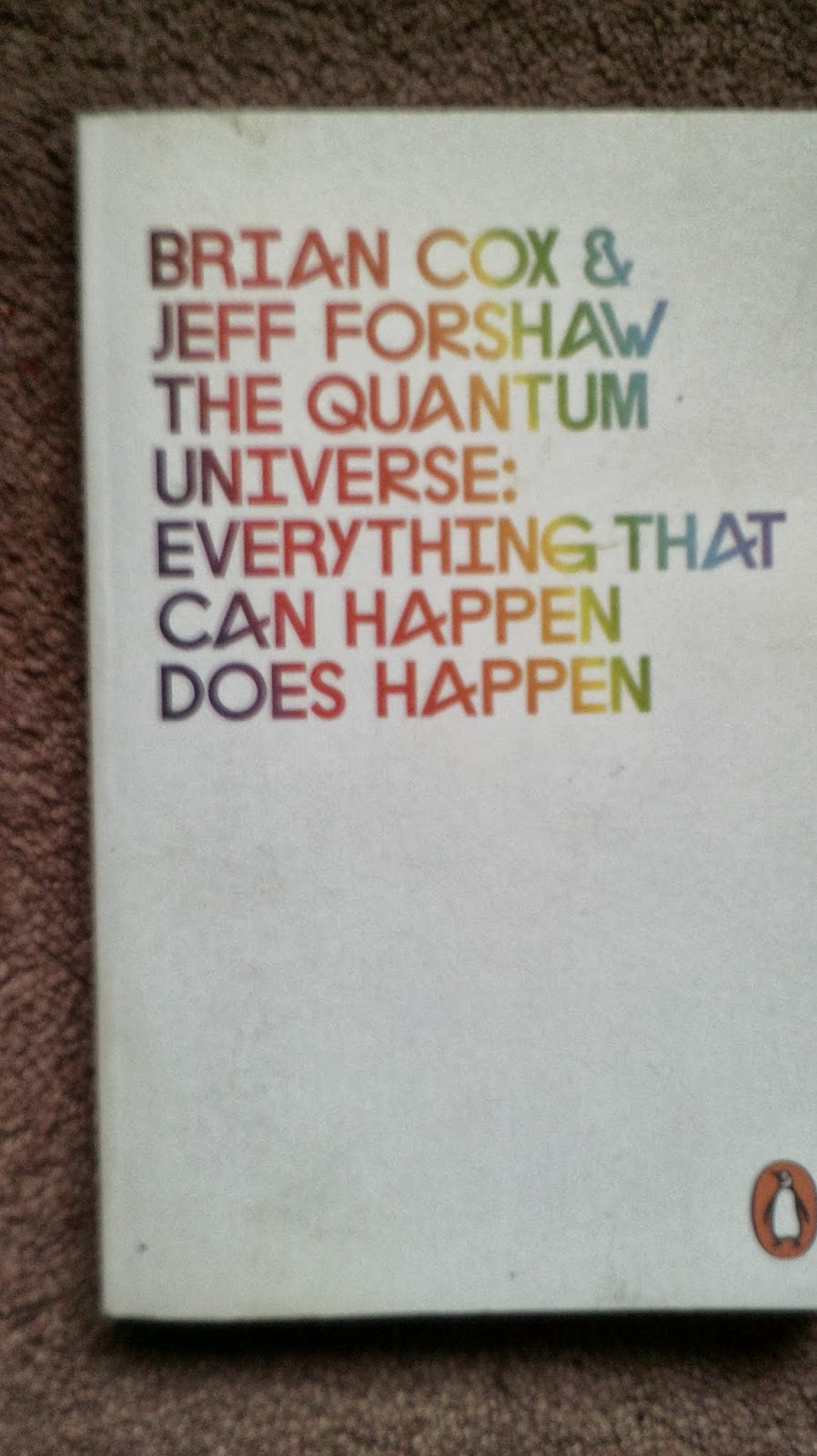
THE QUANTUM UNIVERSE: EVERYTHING THAT CAN HAPPEN DOES HAPPEN by Brian Cox and Jeff Forshaw

 
Niels Bohr, the Danish physicist who invented rather a lot of Quantum Theory, said something along these lines: if you think you understand Quantum Physics then you don't. This book isn't easy, even if you are in the Sixth Form, but you wouldn't expect it to be, given what I've said about the topic. It is as clear an introduction to the topic as you'll find. Quantum Physics is wonderfully weird. It allows parallel universes and a lot of odd things. You won't understand it all whilst you're still at school but it will give you a great head start for future studies.
 
PS We've got more than one copy of this book - it's that important!

THE CHARACTER OF PHYSICAL LAW by Richard Feynman

 
The cool thing about Richard Feynman is that he never wrote a single book, but there are a lot out there claiming to be by Richard Feynman. What happened is that people taped him and then wrote it up. This book is the write-up of a series of lectures that he gave about how physicists use Mathematics in their study of the world and what it means to talk about the Laws of the Universe. Feynman is brilliant at explaining things. I like the explanation of the dissipation of energy in terms of drying yourself with a wet towel. He's my favourite physicist: he worked hard and was clever but never let the authorities push him around.
 
Someone has put all of Chapter 5 on the Internet
http://www.informationphilosopher.com/solutions/scientists/feynman/past_and_future.html

If you'd rather watch him give the lectures instead of reading the book, Bill Gates has paid to put them online: http://research.microsoft.com/apps/tools/tuva/#data=3%7C%7C%7C