Thursday, 26 September 2013

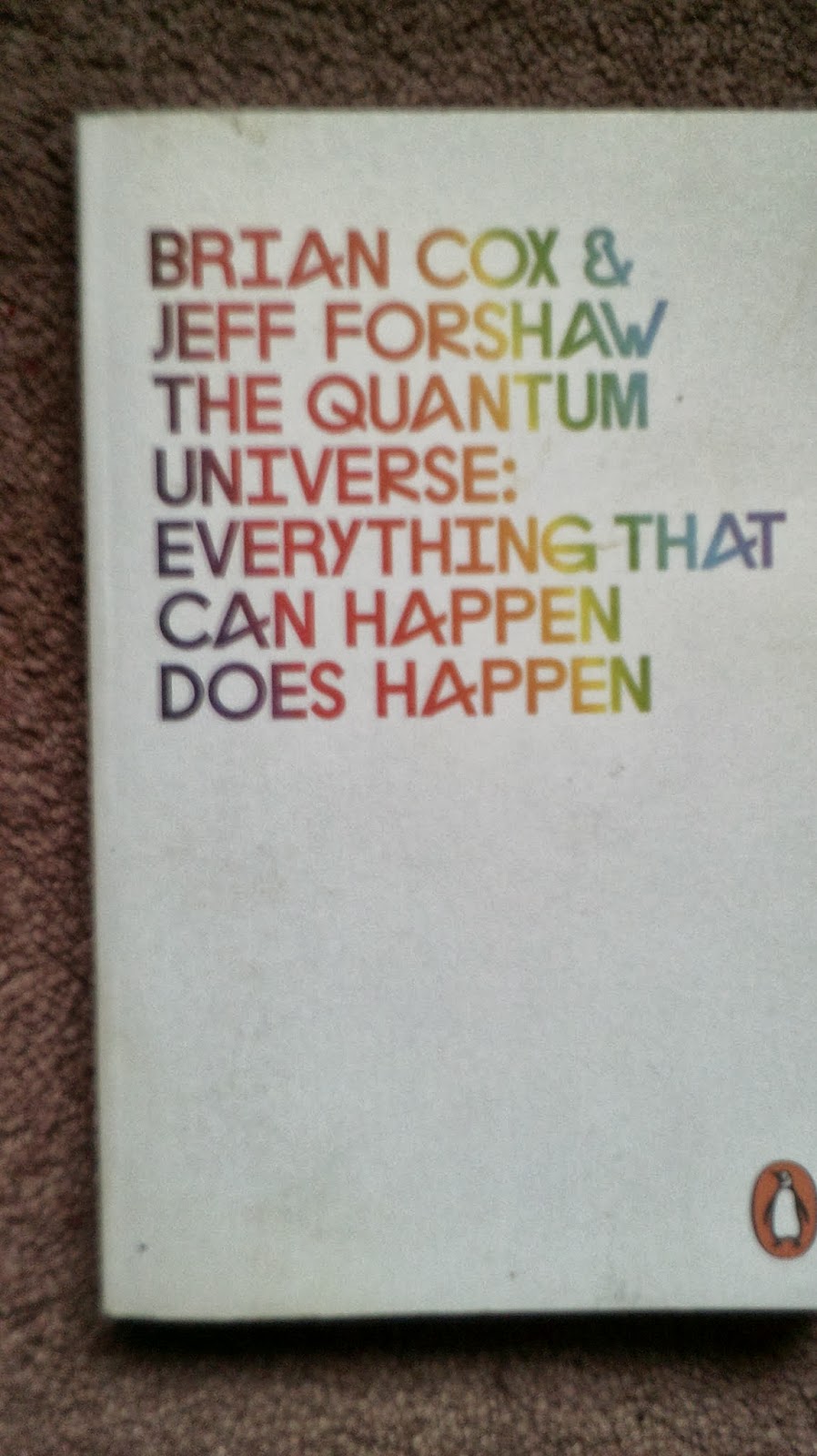
THE QUANTUM UNIVERSE: EVERYTHING THAT CAN HAPPEN DOES HAPPEN by Brian Cox and Jeff Forshaw

 
Niels Bohr, the Danish physicist who invented rather a lot of Quantum Theory, said something along these lines: if you think you understand Quantum Physics then you don't. This book isn't easy, even if you are in the Sixth Form, but you wouldn't expect it to be, given what I've said about the topic. It is as clear an introduction to the topic as you'll find. Quantum Physics is wonderfully weird. It allows parallel universes and a lot of odd things. You won't understand it all whilst you're still at school but it will give you a great head start for future studies.
 
PS We've got more than one copy of this book - it's that important!

THE CHARACTER OF PHYSICAL LAW by Richard Feynman

 
The cool thing about Richard Feynman is that he never wrote a single book, but there are a lot out there claiming to be by Richard Feynman. What happened is that people taped him and then wrote it up. This book is the write-up of a series of lectures that he gave about how physicists use Mathematics in their study of the world and what it means to talk about the Laws of the Universe. Feynman is brilliant at explaining things. I like the explanation of the dissipation of energy in terms of drying yourself with a wet towel. He's my favourite physicist: he worked hard and was clever but never let the authorities push him around.
 
Someone has put all of Chapter 5 on the Internet
http://www.informationphilosopher.com/solutions/scientists/feynman/past_and_future.html

If you'd rather watch him give the lectures instead of reading the book, Bill Gates has paid to put them online: http://research.microsoft.com/apps/tools/tuva/#data=3%7C%7C%7C

Wednesday, 26 June 2013

THE IMMORTAL LIFE OF HENRIETTA LACKS by Rebecca Skloot

 
Henrietta Lacks was an African-American woman who died of cervical cancer in 1951, but her cells are still alive today - which is why she is said to be immortal. Her cells have been used in all sorts of medical research experiments, for example in developing a vaccine for polio. But the important thing about this book is that the woman who should have been the hero had been completely forgotten. No one asked permission to take her cells. No one consulted her family. A journalist called Rebecca Skloot researched the story and the book is in part her own story she traced Henrietta Lacks's family. You should read this if you are interested in Medicine or medical research. Not only does it contain useful scientific details but the searing investigation of medical ethics and racial justice is essential reading.


Thursday, 20 June 2013

SUSTAINABLE ENERGY: Without the Hot Air by David MacKay

 
This is an amazing book, written to be accessible. It goes over the UK's energy problems and possible solutions. David MacKay is a professor at Cambridge University. He backs up his ideas with simple calculations, which are mainly put in a section at the end. It is possible to read what he thinks without looking at the maths. This is probably the best book in our library for Engineering. This book stirred up passionate debate. I even wrote a letter to The Cumberland News in defence of it, because I don't think he wants to cover the whole country in wind farms. David MacKay was so keen that you should read his book that he has made it available for free download on the Internet, if you don't fancy a paper copy: http://www.withouthotair.com/

THE MUSIC OF LIFE by Denis Noble

 
The thesis of this book is that biological systems are not strictly bottom up, with your genes dictating how your cells and bodies work. Denis Noble is a systems biologist. He gives examples in which external conditions can feed down to the genes, changing the way in which a particular gene is expressed (ie how that gene acts in the cell). This is called epigenetics. This is very different to the popular interpretation of Neo-Darwinism put forward by Richard Dawkins in his book "The Selfish Gene" (see previous post). Denis Noble is careful not to rubbish Dawkins but he has his own stance. This book is short and easy to read, and it finishes with a quotation from Wittgenstein. What's not to like?

Monday, 20 May 2013

ERAGON by Christopher Paolini

 
One of my friends lent me this book, telling me how wonderful it was. She was right. Christopher Paolini was 15 when he wrote Eragon but you wouldn't be able to tell. The story concerns a boy called Eragon who lives in an empire run by the evil King Galbatorix. One hundred years ago, Galbatorix killed the Dragon Riders, good people and their dragons who looked after the land of Algaesia. No one was left to stop him. One day, Eragon finds what turns out to be a dragon egg. A dragon called Saphira hatches and together they set off on a series of adventures which might well end up saving the world. What I like best about the series of books is that although there are clearly goodies and baddies, the characters are a bit more complex than that. Some people mean well but do stupid things. Some people seem evil but do decent things. So this might be fantasy fiction but I don't think it's just escapism. You can reflect on the morality of your own actions if you like, Argetlam. In the end, you can change your true name so redemption is possible.

 
I'm half way through the third book Brisingr at the moment.


Not my usual part of the library, but they are in this stack of books.


Monday, 29 April 2013

THE CLOUDSPOTTER'S GUIDE by Gavin Pretor-Pinney


This amazing picture was taken by my friend in the hills above Bassenthwaite in January. It shows a cloud inversion and her Brocken Spectre with a glory around it. I'm jealous because I've never seen one. If you want to know how it forms, read the display in the library, and even better, read the book. The book started out as a spoof, I think. He was trying to laugh at spotters, but discovered that clouds are amazing. The book explains all the types of cloud and how to identify them. The bit I like best is about the pilot who fell through the middle of a lightning storm. The book is easy to read - go on, you know you want to!